What is antenatal education?
Antenatal education is information provided to pregnant women, birthing people, and their partners to help prepare them for labour, the initial phase post birth, and early parenthood.
The NICE recommends that NHS maternity care providers offer antenatal classes to those in their first pregnancies. It also recomends education should be considered for people in second and subsequent pregnancies (and their partners). But it doesn’t say what, how, where, when, or who should deliver it!
The University of Liverpool is conducting some research to find out what people want and value in their antenatal education. Pregnancy is a transformational time. It’s also a process that most of us are pretty unfamiliar with until it happens to us! So good advice and information is essential to help people navigate the pathway and make informed choices.
I’ll let the Liverpool team explain more:
Why focusing on antenatal education matters
A group of researchers from the University of Liverpool is seeking to understand current antenatal education (ANE) in the UK. We’re doing this by engaging with parents, staff, antenatal educators and policy makers.
Antenatal education is recommended in national and international antenatal care guidelines. The aim is to prepare women and partners for birth and the transition to parenthood. While current guidelines state it should be offered, there is no mandate or detail. Moreover, NHS antenatal education was paused in COVID-19 and has not recovered.
We believe through personal communications with community midwives, that access via the NHS is not universal, and from previous research that content and delivery is variable.
Antenatal programs can be delivered by maternity care providers, including the NHS, third sector organisations like NCT, and private practitioners. But what is provided varies in delivery (group; individual), accessibility (in-person; on-line; hybrid; timing), content (general information; specific techniques), and cost.
In the UK, the current lack of availability in the NHS reduces choice. Some women turn to private providers, leading to disparities in access. The NHS Choices website only advertises private providers. The cost of private classes can prohibit access. This is unfair.
A new national study of antenatal education
Our goal is to move towards co-designing a high-quality standardised, universally available antenatal offer. We are:
- Mapping existing NHS antenatal education provision, content, barriers and facilitators.
- Conducting on-line online surveys with women and providers to understand ANE curriculum requirements and underpin ANE programme co-design with women and staff.
- Conducting interviews with maternity leaders, lobby groups, and policymakers to identify barriers and facilitators to national standardisation and implementation.
Have your say
If you are:
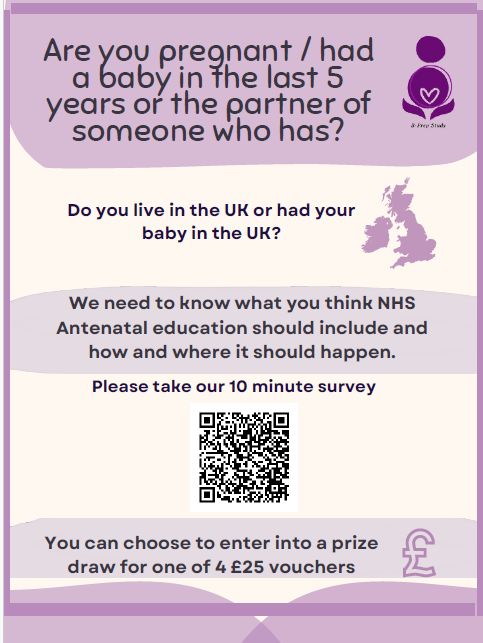
- pregnant or had a baby in the last 5 years
- a partner of someone who has had a baby in the last 5 years, and
- you live in the UK
You can complete the survey here:
The team want to know your experience of antenatal education, what you think antenatal education should include, and how and where you think it should happen.
Everyone who completes the survey can choose to be entered into a prize draw for one of four £25 vouchers.