

Today in my inbox, I received this article: “Maternal obesity doubles the risk of developing autism in children“… I mean, what’s new!? There’s always something about how being fat when pregnant increases risks of EVERYTHING… (Except, of course, it doesn’t. Firstly because correlation is not the same as causation, and secondly because some risks are actually lower when you’re bigger, it’s just you rarely hear about them!) It’s the BMI blinkers again – looking at everything through a narrow lens of health defined by the fundamentally-flawed-but-easy-to-calculate BMI.
This story piqued my interest because there’s plenty of data showing a correlation between neurodiversity (particularly autism) and being in a bigger body, so I would naturally expect a correlation!
And given that autism and high BMI are both highly inheritable traits, I was curious how the researchers had accounted for that. Particularly whether the underdiagnosis of autism in women (possibly as much as 80%)
might at least partially explain the statistical significance (‘double the risk’) reported and whether the researchers had attempted to adjust for that at all?
Did the research even say this?
Obviously I read the news article first, but this not being my first rodeo, I’m aware that media articles don’t always faithfully reproduce the research findings when they report the ‘story’… This isn’t always the media’s doing – sometimes it’s the Universities’ press department sensationalising results and excluding caveats in order to make ‘good copy’!
So, here’s the link to the research paper itself:
What did I discover?
Firstly, it’s not direct research, but rather a review and analysis of existing research. 42 different research studies, to be precise, all looking for links between maternal BMI and various neuropsychiatric outcomes in their offspring.
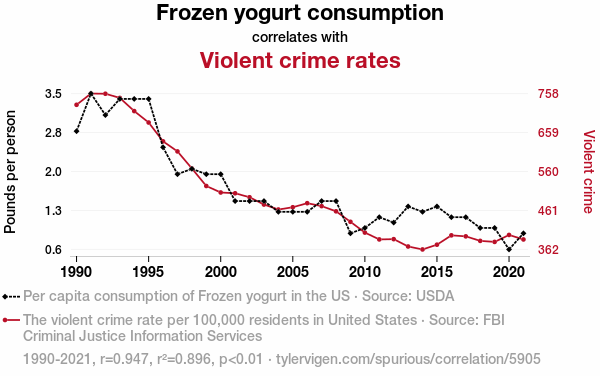
Now, as we know, if you get enough data on enough things, you’re going to start to spot correlations, especially when you’re looking for them… There’s a whole website devoted to this phenomenon you might want to check out:
Second note – they DIDN’T find evidence of correlation between loads of psychiatric conditions they were looking for, including ADHD, eating disorders, and schizophrenia… But ‘high BMI doesn’t cause X, Y and Z…’ isn’t much of a news story, is it? The only decent connection they could find was between maternal obesity and autism.
Thirdly, and what I was most interested in, while the research studies all adjusted for one or more co-variables, including maternal IQ, marital status, smoking status, and birth order…

There is one really GLARINGLY OBVIOUS omission in this table… Yup, you guessed it. Maternal autism status. Not only did they not think to account for undiagnosed maternal autism, as I had suspected… They didn’t look for it AT ALL?! (Unless it’s included in the extremely broad category ‘maternal mental health’ which fewer than half the studies considered).
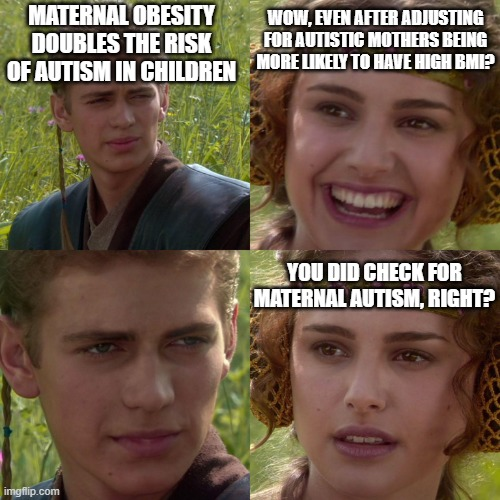
The mind boggles.
The bad science doesn’t end there!
Having determined there’s a correlation, the researchers go on to have a few stabs in the dark at what the causal mechanics for this could be. Oooh, is it “chronic low-grade inflammation, oxidative stress, dysregulated fatty acid metabolism, or hormonal imbalances, affecting the intrauterine environment and disrupting fetal brain development” perhaps?
Facepalm.
Buried deep in the text is the throwaway observation “we also noted attenuation in the strength of associations in the studies that adjusted for maternal mental health conditions, suggesting a predisposition to maternal or paternal mental health problems may partly explain some part of the association reported in our study.” Am I missing something?! How is this buried in the study and not blatantly obvious? And then they drop the concept like a hot potato and go right back to talking about fatty acids and neuroinflammation.
The cherry on the cake?
Obviously they then sleepwalk into more logical fallacy with this statement:
“Preconception weight management may mitigate such adverse effects in the offspring.”
Yup, they went from finding a correlation, to deciding it’s causation, to then predictably prescribing weight management as the solution. Let no-one challenge the orthodoxy that fat = unhealthy, thin = healthy, and that all society’s ills would be fixed if we just lost weight!! *facepalm*
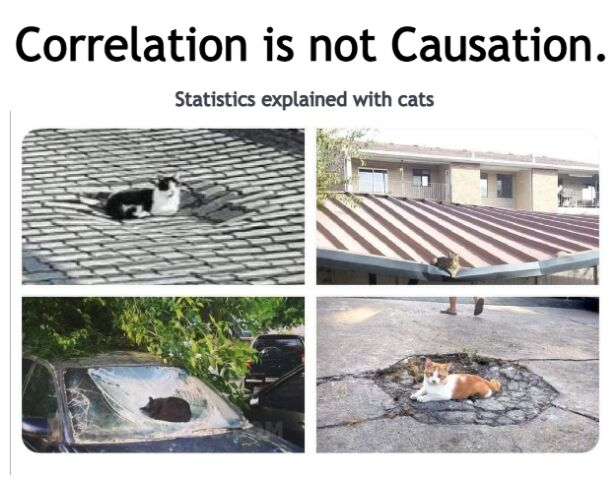
How does a research study with 12 authors, presumably some sort of ethics oversight, and a peer review process before publication lead to this kind of drivel getting published?!
And they’re even so self-congratulatory too! “This comprehensive systematic review and meta-analysis has several strengths.” Well, I guess I could print it out, fold it up, and use it to balance a wobbly table… but beyond that? Sheesh.
When the BMI blinkers are on, the wood is no longer in view – the size of the trees is all that matters.