

The latest MBRRACE 2026 report (or to give it it’s full title: Saving Lives, Improving Mothers’ Care 2026 – Lessons learned to inform maternity care from the UK and Ireland Confidential Enquiries into Maternal Deaths and Morbidity 2022-24) was published last month. And now I’ve had an opportunity to read and digest the information, I’d like to get my thoughts on record. There is plenty in it that deserves attention!
I’d first like to commend the recommendations, summarised in the authors’ 4 key messages. This isn’t a report that focuses on what is at fault with the pregnant population, it’s more interested in asking what maternity services should be doing to serve that population – flaws and all. And that’s refreshing!
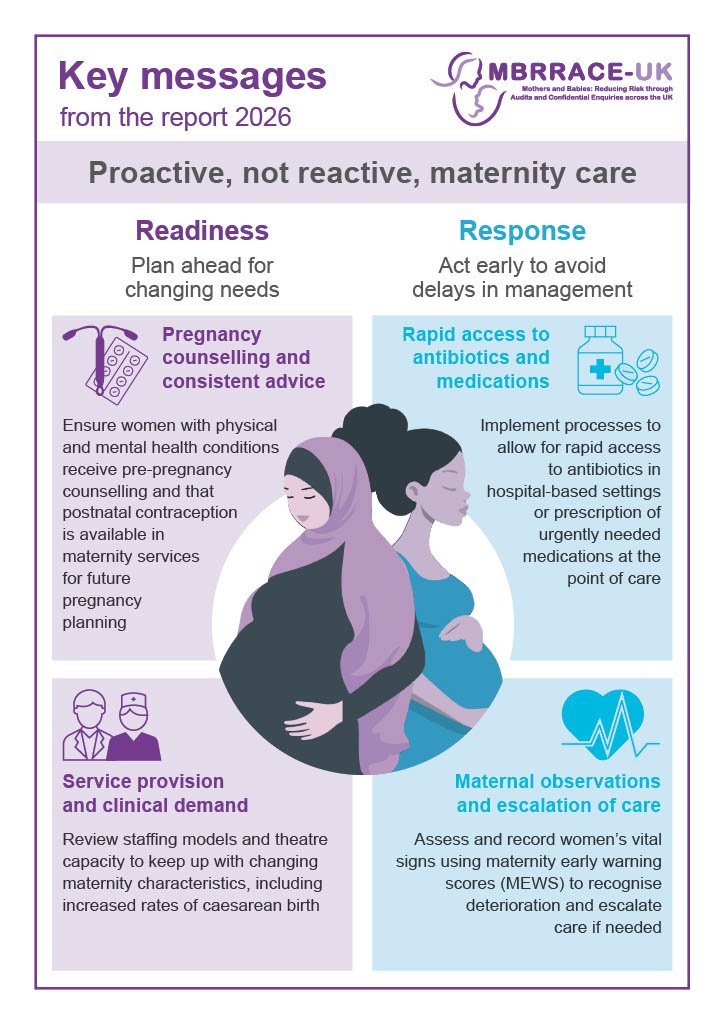
All too often poor statistics get explained away with knowing eye-roll of ‘increasingly complex’ pregnancies. But we’ve known for years that in population terms, people are heavier, having babies later, and are more medically complex than they were 10 years ago. It’s not new news! The NHS can’t simply repeatedly wring it’s hands and complain – it needs to respond to the needs of the population it serves.
Secondly, I’d like to commend a sentence from the excellent Lay Summary: “For every one woman who dies, it is estimated that 100 women will experience a severe morbidity or ‘near miss’ event”. Because while this report specifically and rightly looks at deaths, which are fortunately incredibly rare (less than 0.02% of the 1,969,321 women who gave birth in 2022-24), we know they are the tip of the iceberg when it comes to poor outcomes we want to avoid.
Maternal deaths remain too high
Of course, every single maternal death is a tragedy. Even one death is too many. This report always looks at deaths over a three year period (so there is overlap from one report to the next) precisely because there are so few. But the data is shockingly clear:
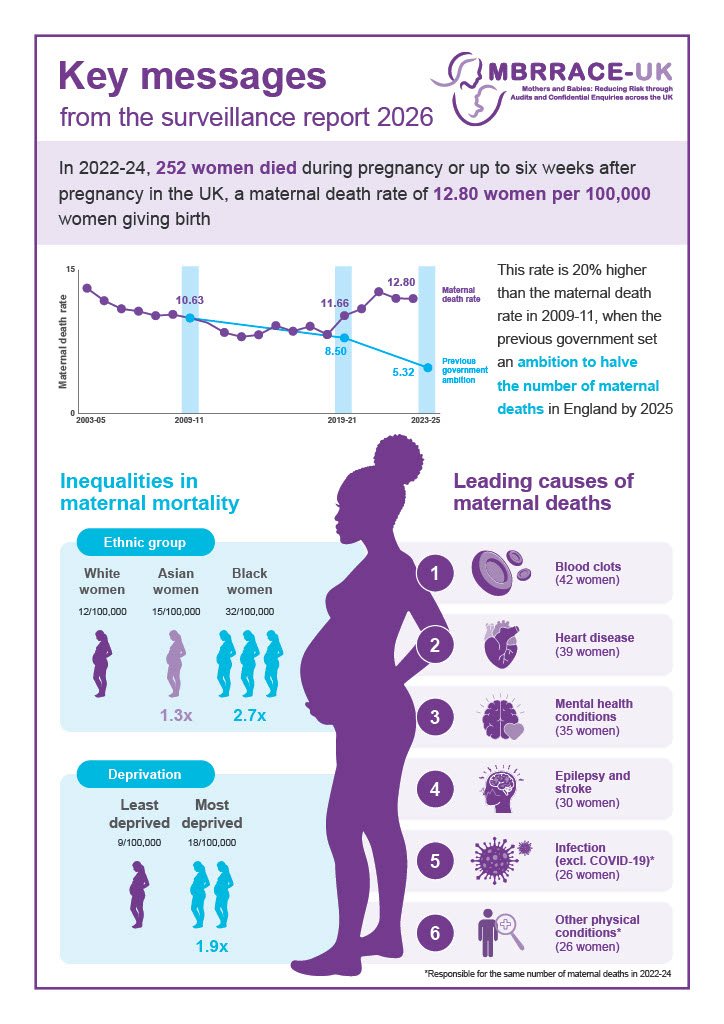
In 2022-24 (the years this report covers) the overall rate of maternal death in the UK was 20% higher than it was in 2009-11. Ironically, that’s when the previous government set an ambition to halve the rate of maternal mortality in 15 years… Not only did we not achieve that target -we’ve gone backwards!? You can see the shift in the graph above.
Now, obviously, Covid played its part – but it doesn’t explain why maternal mortality has remained elevated since. Once COVID deaths are excluded, the rate for 2022-2024 was still 12.49 per 100,000. Before the shift, the rate was around 10% for several years. This rate hasn’t significantly changed over the last four reports. In fact, maternal deaths are higher now than at the height of the pandemic.
What does MBRRACE 2026 say about BMI?
The report (s.2.3.4) highlights that a third of those who died (33%) had a BMI of 30 or above (s.2.3.4), which sounds alarming.
But don’t forget – the data shows that 26.2% of the pregnant population as a whole had a BMI of ≥30. So we’d expect 26.2% of the deaths to be from that cohort even if BMI had no effect on mortality at all.
That doesn’t mean BMI is irrelevant. Higher BMI is associated with some pregnancy complications and can make some aspects of care more challenging – and clearly, people with a BMI ≥30 are overrepresented in the deaths. But it does mean we can’t treat headline statistics like “33% of people who died were obese” as though it tells us that obesity caused a third of maternal deaths. It doesn’t.
To answer that question properly, we need to compare mortality rates for people with different BMIs while accounting for other factors. The MBRRACE BMI figures on their own cannot do that. And as always, finding correlation does not mean you’ve established causation… (I LOVE Tyler Vigen’s Spurious Correlations page for making this point on a daily basis!)
Yes, pregnancies are becoming more complex
We know people are having babies later and that more people enter pregnancy with existing health conditions. s2.3.4 of the MBRRACE 2026 report reiterates that studies have shown that 66% of the increased risk of maternal death in the UK can be attributed to medical comorbidities.
Indeed, 60% of the deaths covered by this report were to people known to have pre-existing medical problems excluding obesity.
But we have known this for years… This was being reported when I was first pregnant in 2010! If we know that a significant proportion of pregnant women and birthing people have obesity, hypertension, diabetes, cardiac disease, mental health conditions, previous caesareans and other complications, then those aren’t unexpected complications anymore.
They’re characteristics of the population maternity services are there to serve.
And that brings us to the really interesting bit. MBRRACE have chosen to really highlight how inequalities, or “Intersectionality of risk factors” as the Lay Summary puts it, are associated with poorer outcomes. We’re still seing almost a three-fold increase in maternal mortality rates for
Black women compared to White women. Women living in the most deprived areas continue to die at a rate twice that of women living in the least deprived areas. And advancing age is implicated too – compared to women aged 25-29, women aged 35 or older were nearly twice as likely to die.
These are all unmodifiable risk factors – Black women can’t become less black, any more than older women can get younger. And while we might like to become less deprived, or thinner, or lose our health conditions before pregnancy, the reality is that it’s not quite that easy…
What do the authors think needs to change?
MBRRACE 2026’s four headline recommendations focus on proactive rather than reactive maternity care. They call for better preparation for pregnancy, rapid access to antibiotics and other medication, maternity staffing and theatre capacity that match clinical demand, and better monitoring so deterioration is recognised and acted upon quickly.
I think it’s about time we focused less on changing people and blaming them for poorer outcomes, and focused more on changing the system to match reality!
Observation. Communication. Action.
One of the key messages is wonderfully simple:
Take observations. Recognise that someone is becoming unwell. Escalate. Act.
Continuity of care isn’t mentioned this year as one of the four headline recommendations. But the phrase pops up repeatedly throughout the report – particularly in the highlighted Safety Messages in bold red boxes. Previous MBRRACE-UK reports and the recent Ockenden report into Nottingham University Hospitals NHS Trust (Ockenden 2026), also emphasised early risk recognition, continuity of care, robust information sharing and timely senior multidisciplinary review for women with additional complexities.
Improving communication is such an obvious recommendation – both between patients and staff, and between different disciplines. Repeatedly, lapses in communication or delays in action have been shown to be crucial.
And I think it’s worth still pushing for continuity of care as a model in midwifery/obstetrics because every new professional encounter has a cost.
You have to explain who you are. They have to work out who you are. They find your notes. You try to bring them up to speed with what’s been happening, and all too soon it’s over and they’re onto the next patient and you’re lucky if you ever see them again. It all takes time. It also makes it easier for important changes to disappear between appointments.
Continuity cannot replace good systems, appropriate staffing or clinical expertise. But familiarity gives clinicians something else – familiarity. A baseline. If you know how someone normally looks, sounds and behaves, a subtle change can be much easier to spot. And for women and pregnant people it gives similar benefits – familiarity, and the opportunity to build rapport, and trust.
We need better care, not more fear
This is what heartens me about MBRRACE 2026. The report doesn’t simply say: pregnant people are older, heavier, and more complicated, therefore pregnancy is more dangerous.
It asks maternity services to become more proactive. We have to do better at safely caring for pregnancies and pregnant people – no matter what complexities they bring with them.
It’s also trying to talk honestly about inequality. About deprivation. Racism. About mental health. About fragmented care. NHS capacity. About whether the system has adapted quickly enough.
The people haven’t failed maternity care by becoming more complex. Maternity care has to rise to the complexity of the people it serves.